Exploring New Frontiers
MSU operates FRIB as a user facility for the U.S. Department of Energy Office of Science (DOE-SC), with financial support from and furthering the mission of the DOE-SC Office of Nuclear Physics.
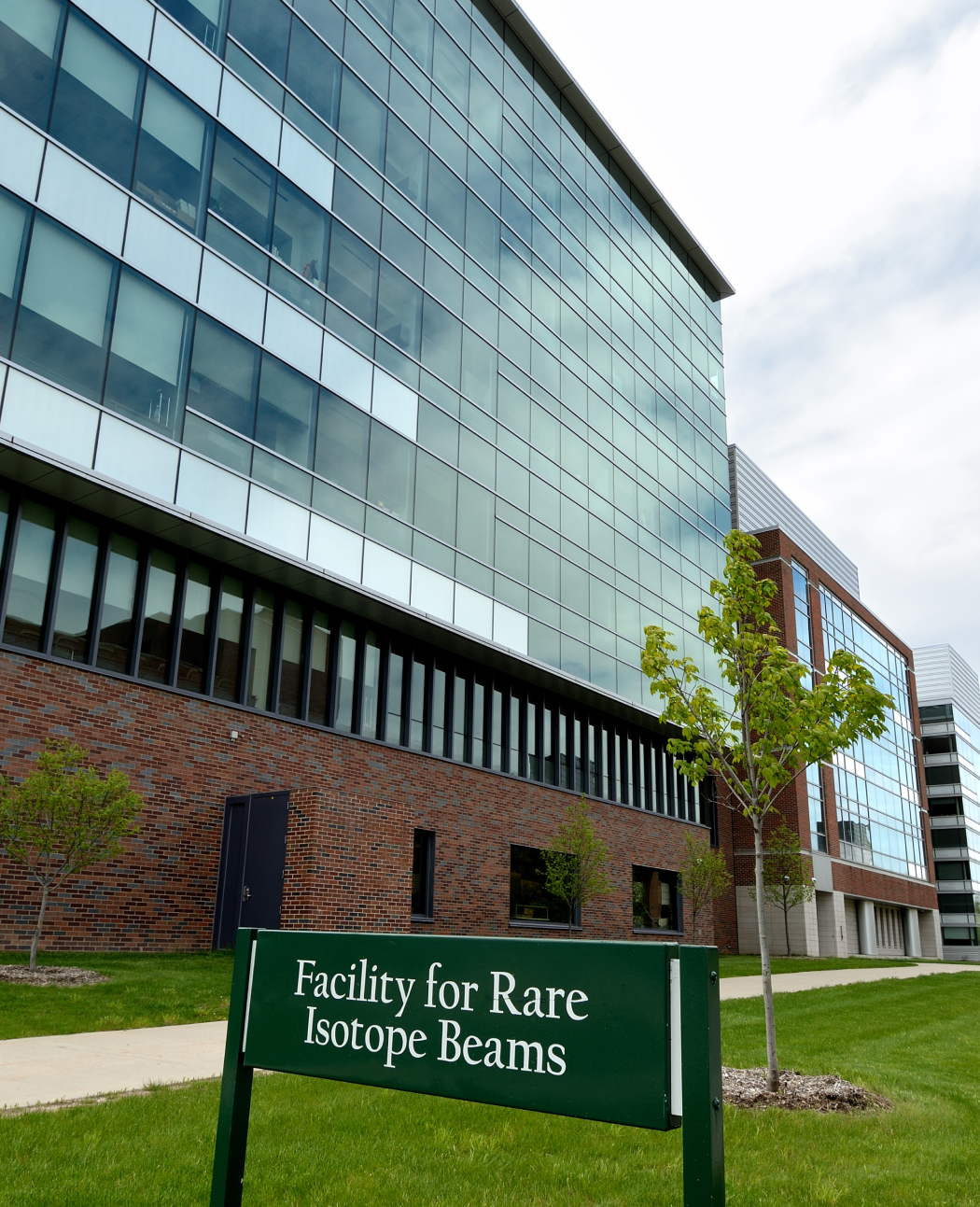
FRIB is where researchers from all career stages and backgrounds come together to make discoveries that change the world. They study the properties and fundamental interactions of rare isotopes and nuclear astrophysics and their impact on medicine, homeland security, and industry.
Home to a top-ranked U.S. nuclear physics graduate program, FRIB provides researchers with the most advanced tools of modern science, including the most powerful heavy-ion accelerator.
Researching the properties and interactions of rare isotopes—short-lived nuclei not normally found on Earth—paves the way for scientific breakthroughs, including new approaches to diagnosing and treating cancer and other diseases, and strengthening national security.
Advancing basic research
FRIB enables scientists to make discoveries about the properties of rare isotopes, nuclear astrophysics, fundamental interactions, and applications for society, including in medicine, homeland security, and industry. FRIB’s high-power superconducting linear accelerator (linac) accelerates all ions from hydrogen to uranium to at least 200 MeV/nucleon and produces rare isotopes by in-beam fragmentation. FRIB provides intense beams of rare isotopes (short-lived nuclei not normally found on Earth). FRIB enables scientific research with fast, stopped, and reaccelerated rare isotope beams, supporting a community of scientists.
Why it’s important
With FRIB we, for the first time, have the capability to produce most of the same rare isotopes that are created in the cosmos, which then decay into the elements found on Earth. This helps us understand the origins of the elements. The same isotopes are needed to develop a predictive model of atomic nuclei and how they interact.
Researchers using FRIB are able to improve our understanding of how atomic nuclei may be used to diagnose and cure diseases. Improved nuclear models and precision data allow optimization of the next generation of nuclear reactors and evaluation of techniques to destroy nuclear waste. They probe advanced materials to examine the processes involved on the nano- and micro-scale, providing insights into how materials are affected by radiation and other forces. Modeling atomic nuclei and their interactions—a challenging problem in science—can also help lead to breakthroughs in energy, security, medicine, the environment, and more.
FRIB has the foundation, partnerships, and opportunities critical to enable breakthrough discoveries in nuclear science and applications for the benefit of society and to support a better world.
FRIB leadership
The leadership team guides a dedicated group of experts to operate FRIB as a world-class scientific facility.
FRIB allows scientists to explore the properties of rare isotopes, advancing our understanding of nuclear physics, nuclear astrophysics, fundamental forces, and practical applications that benefit society.
FRIB empowers groundbreaking discoveries in nuclear physics for societal advancement.
Consistent with MSU’s long history of external scientific collaboration, the FRIB Laboratory is advised by five external advisory committees.
FRIB draws on expertise from DOE-SC national laboratories, universities, and external partners.
FRIB maintains a best-in-class supplier base for procurement of goods and services.
Downloadable fact sheets showcase FRIB's key research, development, and contacts.
FRIB tours
Interested members of the public and students from public, homeschool, private, and parochial schools can discover what happens at a rare isotope facility by joining an FRIB tour.
Join a nationally top-ranked nuclear physics graduate program
Pursue a rewarding career through graduate research in experimental or theoretical nuclear physics, nuclear chemistry, nuclear astrophysics, cryogenic engineering, or accelerator science.

