Instruments
SECAR is a separator for the measurement of reaction rates on proton-rich unstable nuclei in the astrophysical rapid proton capture process.
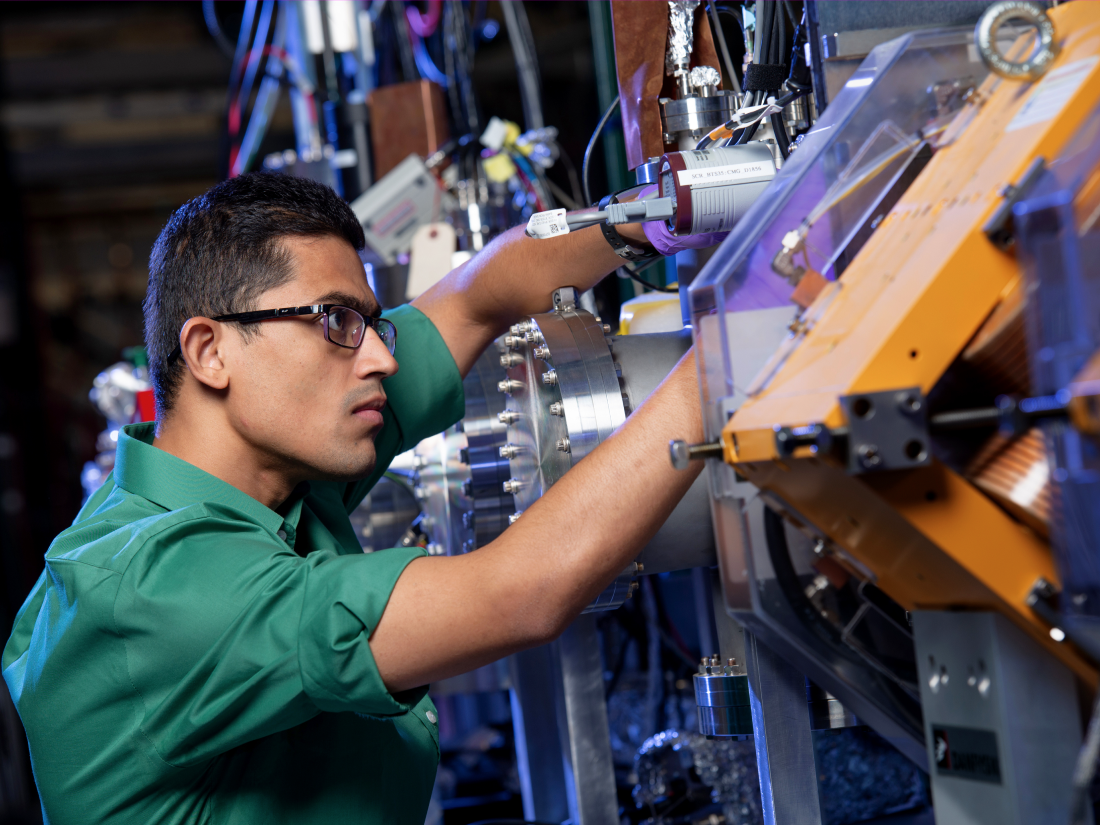
Status: Operational
Location: ReA3 Hall
Contact person: Hendrik Schatz
Overview
SECAR is the flagship instrument for the FRIB nuclear astrophysics community. SECAR is optimized for the direct measurement of capture reactions on unstable nuclei that drive some stars to explode and synthesize crucial nuclei that make up our bodies and our world. Researchers will utilize SECAR for measurements to improve our understanding of novae, X-ray bursts, supernovae, and other explosive and exotic astrophysical environments.
SECAR will take advantage of the ReA3 re-accelerator that provides unique radioactive beams at low astrophysical energies. SECAR measurements will address open questions related to extreme astrophysical sites, including novae, x-ray bursts, supernovae, and supermassive stars.
SECAR is designed to have a performance that significantly exceeds that of all previous recoils separators used for astrophysics measurements.
The SECAR collaboration currently includes nuclear astrophysics groups from Argonne National Laboratory, Central Michigan University, Colorado School of Mines, Louisiana State University, McMaster University, Michigan State University, University of Notre Dame, Oak Ridge National Lab, and South Dakota School of Mines.
Technical detail
SECAR is a 40-meter-long system of magnets and electrostatic elements placed along the beam axis in the ReA3 hall. SECAR is optimized for measurements of low-energy proton- and alpha-capture reactions that are critical to understand how stars explode. Heavy ion beams of proton-rich unstable nuclei (with masses up to A = 65) will bombard the JENSA hydrogen gas jet target. Capture reaction recoils will enter the system along with unreacted beam particles of intensity more than 13 orders of magnitude higher. A dipole-magnet based charge state selection section is followed by two velocity filter-based sections for projectile rejection, and then a final dipole-magnet based clean up section is followed by the focal plane detector system.
The most critical components of the system are the two velocity filters. Each is 2.5 m long, contains horizontal Ti electrodes with a 22 cm gap and an electric field gradient over 2.5 kV/m and a voltage of over +/- 250 kV. The electromagnet surrounding the charged electrostatic plates has a maximum field of 0.12 T with a vertical pole gap of 900 mm and weighs over 15000 kg. The nominal ion optical bending radius of each filter is 7 m.
The separator is designed for a factor of 1013 rejection of the unreacted projectiles, with another factor of 104 rejection coming from the two position-sensitive microchannel plate detectors and the gas ionization counter at the focal plane. An array of BGO scintillator detectors are placed around the target system to enable coincidence measurements of capture gamma rays with recoils detected at the focal plane, which can further improve the projectile rejection. The angular and energy acceptances of SECAR are designed to be +/- 25 mrad and +/- 3.1%, respectively, and the maximum rigidity will be 0.8 Tm. The mass resolution of the system is designed to be 760.
Although the ion optics are optimized for (p, gamma) and (alpha, gamma) reactions, other reactions such as (alpha, n) and (d, p) can be measured with the system.
Funding acknowledgement: SECAR is supported by the U.S. Department of Energy, Office of Science, Office of Nuclear Physics, under award DE-SC0014384 and by the National Science Foundation under grant PHY 1624942.

