Highlighting FRIB Stories
Latest updates, research breakthroughs, and facility announcements for FRIB
Website articles and press releases about FRIB science.


External news and journal publications discussing FRIB science.
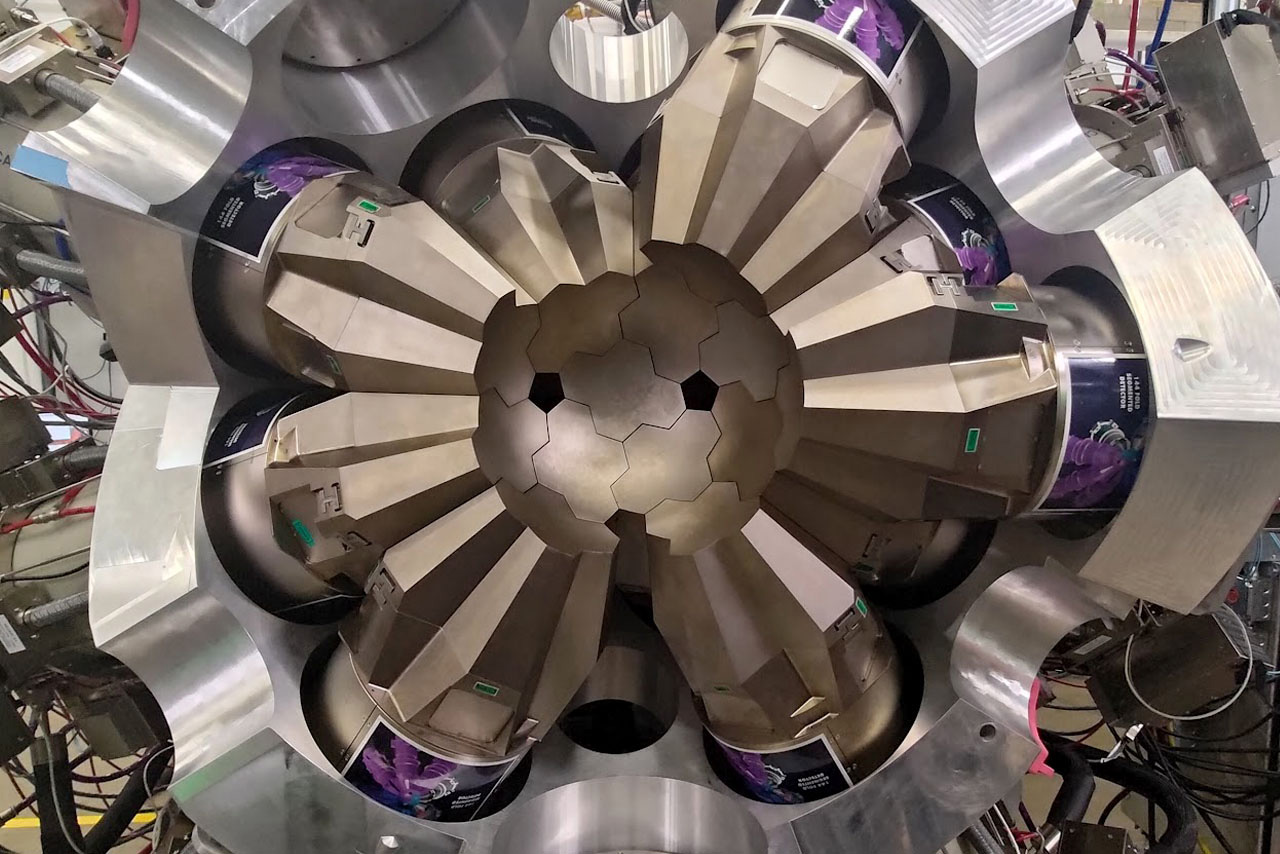
A next-generation nuclear detection system that could aid US national security efforts has logged its first operational measurements in Michigan. The Gamma-Ray Energy Tracking Array, known as GRETA, recently completed its initial characterization run at Michigan State University. Located at FRIB, the instrument met all primary performance targets during early beam testing.
For decades, some atomic nuclei have emitted more low-energy gamma rays than theory could explain. A collaboration led by researchers at FRIB has now traced this mysterious excess in zinc-70 to magnetic transitions occurring inside the nucleus. The findings are reported in a study recently published in Nature.
Michigan State University and Apple hosted the inaugural Apple Manufacturing Academy Spring Forum, bringing together industry leaders, researchers, and manufacturers to explore how artificial intelligence is reshaping manufacturing and supply-chain operations. The event included keynote sessions, poster presentations, and tours of facilities such as FRIB, where participants saw examples of advanced technology and operational innovation in practice.
Michigan State University's K500 Chip Testing Facility, inaugurated in February at FRIB, cost approximately $14 million to establish, with funding provided by the U.S. Department of Defense. The project repurposed the campus' K500 superconducting cyclotron, completed in 1982 for high-energy, heavy-ion research, including producing and accelerating ion beams to study nuclear structure, to now allow the facility to test semiconductors for space, defense and on-Earth applications.
Laboratory Update for Users
The LUU is a newsletter for FRIB users that features noteworthy news and updates at the laboratory.
Laboratory Update for Alumni
The LUA newsletter for FRIB alumni features significant research and project milestones.

