Moore Foundation invests in MSU research on quantum science and fundamental physics

Share this article:
Share this article:
Michigan State University (MSU) physicists are advancing quantum computing and helping to unravel the mysteries of the universe. Now, two are receiving private $1.3 million, five-year grants that will further launch their research and give them more opportunities to collaborate.
Jaideep Taggart Singh, associate professor of physics at FRIB and in the Department of Physics and Astronomy, and Johannes Pollanen, the Cowen Distinguished Chair in Experimental Physics and associate professor in the Department of Physics and Astronomy, were chosen for the Gordon and Betty Moore Foundation 2025 cohort of Experimental Physics Investigators. They join the previous three cohorts of distinguished mid-career researchers to advance fundamental research and push the boundaries of experimental physics.
The mission of the Moore Foundation is to create positive outcomes for future generations by tackling large, important issues at a scale where researchers can achieve significant and measurable impacts. The Experimental Physics Investigators Initiative was established to help the next generation of scientific leaders achieve remarkable physics insights and open new frontiers. The goal of the initiative is to provide substantial funding to pursue exciting research goals, try new ideas and investigate new areas of discovery.
Understanding the makeup of the universe
 Singh’s research focuses on investigating the fundamental imbalance between matter and antimatter in the universe. To do this, his team is studying a rare, short-lived atomic nucleus called protactinium-229, which is thought to have an unusual pear-shaped structure. This shape may make it especially sensitive to unknown physical forces that behave differently when time is reversed—forces that could help explain why the visible universe contains mostly matter.
By embedding these nuclei in special cryogenic crystals and measuring subtle changes using precision instruments, Singh’s work aims to develop a highly sensitive new method for detecting signs of physics beyond current scientific understanding. Thanks to the Moore Foundation grant, this tabletop experiment could offer insights at energy scales far beyond what today’s particle accelerators can reach.
"One of the biggest unanswered questions in physics is why the universe is made mostly of matter and not equal parts of matter and antimatter,” said Singh. “Our research is trying to uncover whether there are hidden forces in nature—ones that behave differently if time were reversed—that could explain this imbalance. By studying a rare and unusually shaped atomic nucleus in a new way, we hope to open a window into physics that current experiments haven’t been able to reach."
Singh earned a bachelor of science degree in physics at the California Institute of Technology and a PhD in experimental nuclear physics at the University of Virginia. He was a Director’s Postdoctoral Fellow at Argonne National Laboratory and a postdoctoral research scientist at Technische Universitaet Muenchen in Germany. In 2014, he joined MSU as an assistant professor in experimental nuclear science and began his research at the National Superconducting Cyclotron Laboratory, FRIB’s predecessor. He currently manages the Spinlab at FRIB. He has received a National Science Foundation Faculty Early Career Development (CAREER) award and a DOE Early Career Research Program award.
Exploring and harnessing the unknown in physics
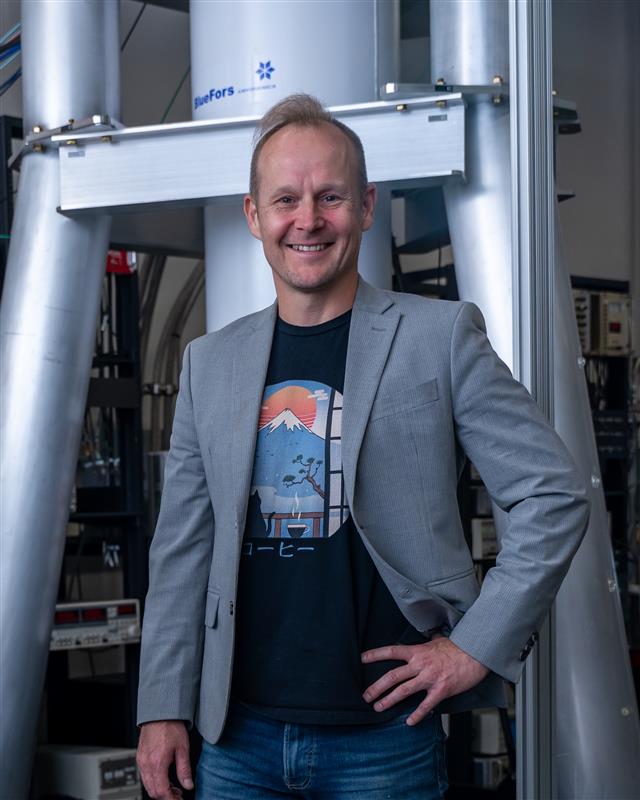 Pollanen’s research pioneers a completely new way to investigate how electrons behave when confined to one- and two-dimensional structures and how they can be harnessed for quantum technologies. Pollanen will create devices for combining superconducting quantum circuits and qubits — the basic building blocks of quantum computing — with electrons floating on liquid helium. These are two physical modalities that have never been fully combined before.
Today’s classical computers and networks are possible thanks to semiconductor transistors, liquid crystals, magnetic materials and optical fibers. Similarly, Pollanen envisions hybrid systems, combining superconducting qubits and trapped electrons will help to build the backbone of future quantum technologies for computing, sensing and communications. The Moore Foundation grant will help him merge these two disparate but complementary systems to address open questions about how to build and understand increasingly complex quantum devices.
He also hopes to answer fundamental questions about the physical world, which is governed by quantum physics. This is important for sating human curiosity, but it could also lay the groundwork for future technology.
“This award from the Moore Foundation will allow my research group to embark on exciting new directions in quantum science, allowing us to address both fundamental and applied questions,” Pollanen said. “This award is a testament to the amazing work of my group’s junior researchers, as well as MSU’s amazing ecosystem for scientific discovery and collaboration."
Pollanen leads the Laboratory for Hybrid Quantum Systems (LHQS) at MSU, where his research group investigates the fundamental physics and quantum information applications of systems comprised of trapped electrons, superconducting qubits, color-center defects in diamond and two-dimensional layered materials. Pollanen holds the Cowen Distinguished Chair in Experimental Physics and also serves as the Associate Director of the MSU Center for Quantum Computing Science and Engineering (MSU-Q) and is a co-founder and board member of the Midwest Quantum Collaboratory. He is also a recipient of the NSF CAREER Award. Before joining the faculty at MSU, Pollanen was a IQIM Postdoctoral Scholar at the Institute for Quantum Information and Matter at Caltech. Pollanen received his Ph.D. from Northwestern University and a Bachelor of Science in physics from the University of North Carolina at Chapel Hill.
Read the original article at MSU Today.
The Gordon and Betty Moore Foundation advances scientific discovery, environmental conservation, and the special character of the San Francisco Bay Area. Visit moore.org and follow @MooreFound.
Michigan State University (MSU) operates the Facility for Rare Isotope Beams (FRIB) as a user facility for the U.S. Department of Energy Office of Science (DOE-SC), with financial support from and furthering the mission of the DOE-SC Office of Nuclear Physics. Hosting the most powerful heavy-ion accelerator, FRIB enables scientists to make discoveries about the properties of rare isotopes in order to better understand the physics of nuclei, nuclear astrophysics, fundamental interactions, and applications for society, including in medicine, homeland security, and industry. User facility operation is supported by the DOE-SC Office of Nuclear Physics as one of 28 DOE-SC user facilities.
The U.S. Department of Energy Office of Science is the single largest supporter of basic research in the physical sciences in the United States and is working to address some of today’s most pressing challenges. For more information, visit energy.gov/science.

