Alumni Spotlight
Zachary Matheson earned a PhD in nuclear physics from Michigan State University, and he was at the National Superconducting Cyclotron Laboratory (NSCL) from 2014-2019. He is currently a physical scientist at the National Nuclear Security Administration (NNSA) in Washington, D.C.
As a part of his duties at NNSA, Matheson works in the Office of Analysis and Evaluation, where he uses modeling and simulation to help leaders make informed decisions.
As a graduate student at NSCL, Matheson focused his research on using high-performance computing to study fission in exotic nuclei. His graduate school was funded through an NNSA academic program.
Matheson spent a year as a graduate fellow with the NNSA Office of Advanced Simulation and Computing after graduation. His main contributions during that time were white papers on topics such as qubit technologies, physics-informed machine learning, and high-performance computing (HPC) software stacks for deep learning. Matheson also participated in administrative activities such as a report on machine learning that was submitted to the U.S. Congress. Following his fellowship, he joined NNSA as a full-time federal employee. His current supervisor, Charles Loelius, is also an NSCL alum.
Matheson indicated that his time spent at NSCL and FRIB—during its construction phase—gave him a unique experience that sets him apart from other colleagues.
“Unlike many grad school experiences, NSCL/FRIB is a large collaborative scientific environment that brings together not only different scientists, but engineers, craftspeople, technicians, administrators, project managers, and more,” he said. “I was at NSCL while FRIB was under construction, and while the lab was transitioning into a DOE-SC user facility. These are all things I did not really appreciate at the time, but they are relevant to me now at my current job. Before I was focused on my specific contribution as a scientist, and now I am on the DOE side and I have to think about all the pieces working in tandem. My previous experience as a student at NSCL/FRIB, even though I didn’t fully understand it, gave me a ‘boots-on-the-ground’ perspective that most of my colleagues lack.”
Matheson also credited his advisor, FRIB Chief Scientist Witek Nazarewicz, for helping him develop the skill of presenting.
“Witek did a good job of making sure that I had plenty of opportunities to present my work in front of an audience,” he said. “That is a habit that I’ve carried with me, despite the fact that it is not expected of me like it was in academia.”
Looking back on his time at NSCL/FRIB, Matheson noted the variety of invited guests that spoke to the graduate students that helped him prepare for his current role.
“There were plenty of visiting academics, sure, but also a lot of people who have made a career outside academia, or even outside physics,” he said. “The lab would arrange for visiting speakers to have lunch with grad students, and I tried to attend as many of those lunches as possible. It was jarring for me to leave academia – as I know it is for a lot of people – so I appreciate that the lab proactively tried to prepare students like me for the reality that most of us will not end up becoming professors.”
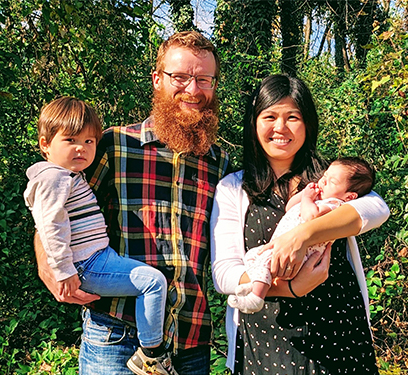
Matheson and his wife welcomed their second child in October 2023. With any free time that remains, you may find him reading science fiction or playing with LEGO.

