Adjunct Assistant Professor
Joined the laboratory in 2020
Education & Training
- BS, Engineering, Université libre de Bruxelles, Belgium, 2013
- BS, Economics, Université libre de Bruxelles, Belgium, 2016
- MS, Physical Engineering, Université libre de Bruxelles, Belgium, 2016
- PhD, Nuclear Physics, Université libre de Bruxelles, Belgium, 2020
Research focus
- Theoretical nuclear physics
Contact information
Links
Research
My research focuses on improving the theoretical description of reactions involving exotic nuclei that is needed to interpret experimental data and to arrive at a more fundamental understanding of the nuclear structure and reactions. My work touches on both improvements of few-body models for direct reactions, such as breakup, knockout, transfer, and ab initio predictions for reactions of astrophysical interests. Accurately predicting these reaction probabilities is key to unveiling exotic phenomena away from stability, such as the formation of halos, and to improve our understanding of the nucleosynthesis occurring in stars. My goal is to strengthen the link between reaction observables and the underlying nuclear structure. My research will strongly benefit the analysis of reaction measurements, the planning of future experiments at FRIB, and it will improve our predictive power for reactions that cannot be reached experimentally.
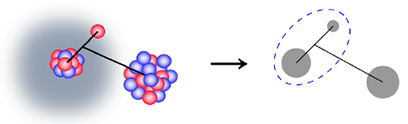
From ab initio to few-body description of reactions.
Biography
I did all of my studies in my hometown, Brussels, in Belgium. Eager to learn, I have studied both economics and engineering. I graduated with my two bachelors and my master degree in 2016. My interests for nuclear physics grew during my master thesis and drove me to apply for a PhD fellowship. I have conducted my PhD partly in Belgium and partly in Germany, and moved to the U.S. in 2020. I was a FRIB Theory Fellow at Lawrence Livermore National Laboratory until August 2023, and I recently moved to FRIB at MSU as Assistant Professor of Physics. My research focuses on improving the theoretical description of reactions involving very short-lived nuclei. I am particularly interested in the study of exotic phenomena arising close to the driplines nuclei, such as the halo formation, and in reactions of interest for astrophysics.
How students can contribute as part of my research team
Students are the driving force of my research group! When they join the team, they will join all group meetings, and take part in the discussion of the ongoing projects. They will also get a warm-up research project, which will give them a taste of the research conducted within the group. By the end of their PhD, they will have taken part in all aspects of modern theoretical nuclear physics, such as identifying a research question, carrying out the theoretical developments to answer this question, writing scientific code studying different physical cases, writing scientific papers, and presenting their results at conferences.
Scientific publications
- Ab InitioPrediction of the 4He(d,γ)6Li Big Bang Radiative Capture, C. Hebborn, Hupin, K. Kravvaris, S. Quaglioni, P. Navratil and P. Gysbers, Phys. Rev. Lett. 129, 042503 (2022).
- Halo effective field theory analysis of one-neutron knockout reactions of 11Beand 15C, Hebborn and P. Capel, Phys. Rev. C 104, 024616 (2021).
- Optical potentials for the rare-isotope beam era, C. Hebborn et al., Phys. G: Nucl. Part. Phys.50 060501 (2023)
- New perspectives on spectroscopic factor quenching from reactions, C. Hebborn, F. M. Nunes and A. E. Lovell, Phys. Rev. Lett. In print.
- Impact of the 6Li asymptotic normalization constant onto α-induced reactions of astrophysical interest, C. Hebborn, M. L. Avila, K. Kravvaris, G. Potel and S. Quaglioni, arXiv:2307.05636 (2023)

