Graduate student working at FRIB. Find out more

Welcome to FRIB

The Facility for Rare Isotope Beams (FRIB) at Michigan State University (MSU) is a world-class research and training center, hosting the most powerful rare-isotope accelerator. MSU operates FRIB as a user facility for the U.S. Department of Energy Office of Science (DOE-SC), with financial support from and furthering the mission of the DOE-SC Office of Nuclear Physics. FRIB is where researchers come together to make discoveries that change the world. They study the properties and fundamental interactions of rare isotopes and nuclear astrophysics and their impact on medicine, homeland security, and industry.

Research areas

FRIB advances nuclear science by improving our understanding of nuclei and their role in the universe, while also advancing accelerator systems.

Explore FRIB research areas

Capabilities

In establishing and operating FRIB, capabilities were developed that transfer to other industries and applications.

Explore FRIB capabilities
View all news
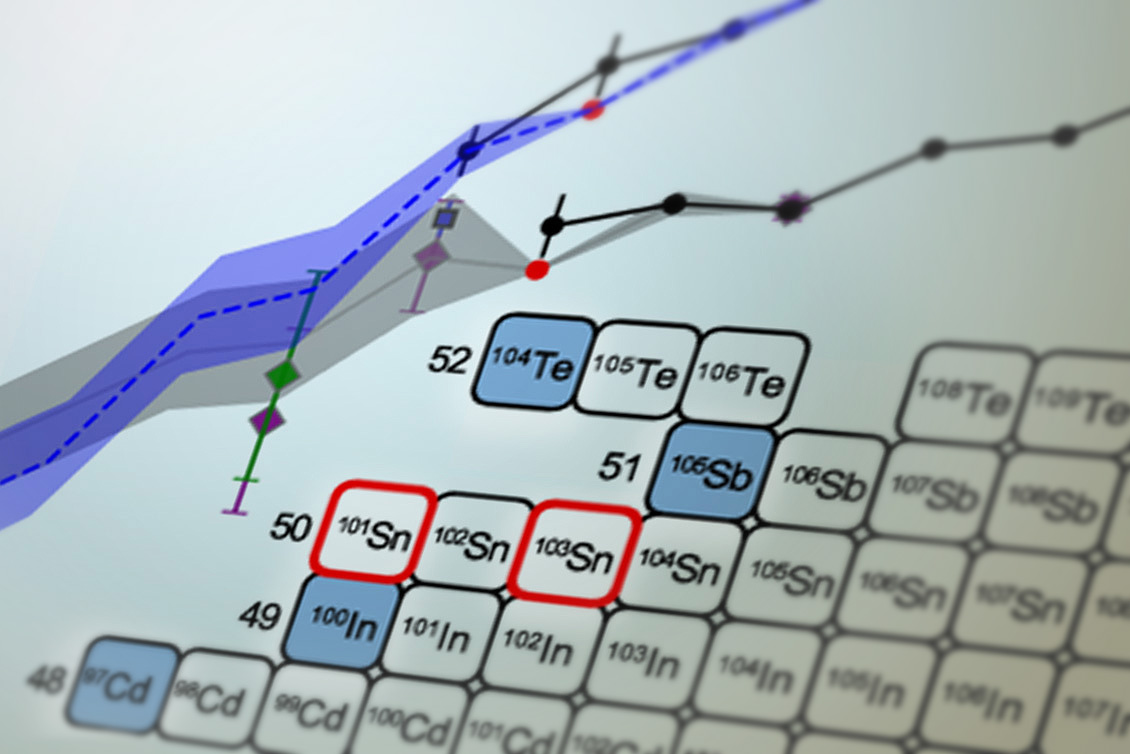
Tin-101 and tin-103 highlighted in a chart
Artificial intelligence/machine learning graphic A graphic showing surrogate models for linear responses

User facilities

FRIB hosts the world’s most powerful heavy-ion accelerator and enables discoveries in rare isotopes, nuclear astrophysics, fundamental interactions, and societal applications like medicine, security, and industry.

Explore FRIB user facilities

Learn more about upcoming events taking place at FRIB. 

View all events
  • 22 April 2026
  • 3:30 EDT
Connecting experiments with rare isotopes to stellar abundances The origin of the heavy elements in the first r-process peak, between strontium and silver, observed in Galactic halo stars (limited-r stars), remains an open question. Neutrino-driven winds in explosive environments—either neutron-rich (weak r-process/α-process) or proton-rich (νp-process)— provide viable production sites. In this seminar, I will discuss how we can distinguish between these scenarios by constraining key nuclear physics uncertainties, particularly (α,n) reaction rates relevant to the weak r-process, and by comparing nucleosynthesis models to the abundance patterns observed in limited-r stars. I will highlight recent and ongoing experimental efforts at Argonne National Laboratory and TRIUMF, as well as new opportunities at FRIB, aimed at measuring critical reaction rates. Together with new high-quality spectroscopic observations, these efforts provide essential constraints for the next generation of astrophysical models.
  • 24 April 2026
  • 2:00 EDT
A unifying framework for resonance scattering and direct reactions in nuclear astrophysics: a case study of 12C(a,g)16O Helium burning, governed primarily by the triple-α and 12C(a,g)16O reactions, plays a central role in stellar evolution, supernova progenitors, and the cosmic carbon-to-oxygen ratio. In particular, the remaining uncertainty in the 12C(a,g)16O reaction rate continues to represent one of the most important open problems in nuclear astrophysics. At the same time, the relevant states in 12C and 16O exhibit pronounced clustering, linking astrophysical reaction rates directly to emergent nuclear structure. In this talk, I will present ongoing efforts toward a unified framework that connects resonant scattering, transfer/direct reactions, and radiative capture within a common formalism. Although resonance scattering and direct reactions provide complementary information on nuclear structure, they are often treated in disconnected ways, while direct reaction analyses can show substantial method dependence and internal inconsistency. The framework builds on R-matrix theory while extending its application to consistently relate information obtained from different experimental methods. Using the 12C(a,g)16O reaction as a case study, I will discuss how combining both resonant scattering and direct reactions can improve constraints on the astrophysical S-factor for 12C(a,g)16O reaction. More broadly, this approach may help establish more consistent links between reaction observables and underlying nuclear structure across a range of light-ion systems.
  • 24 April 2026
  • 3:00 EDT
An experiment that generated a dipole field of 5.99 T at 4.2 K using high-temperature superconducting CORC(R) wires Superconducting magnets enable energy-frontier accelerators by generating strong magnetic fields to steer and focus the particles. Although high-temperature superconductors such as REBCO (REBCO RE = rare earth) hold a strong potential for generating a higher magnetic field than Nb-Ti and N Nb3Sn, the associated magnet and conductor technology for accelerator applications is still in its infancy. The U.S. Magnet Development Program is developing REBCO magnet technology in collaboration with industry. Here we report an experiment on making a dipole magnet called C3 using commercial high-temperature superconducting CORC(R) wires. The magnet, following a canted cosθ design, generated a dipole field of 5.99 T at 4.2 K in its clear aperture of 65 mm at 6.795 kA when a resistive voltage of 105 microV appeared across one of the coils in the magnet. The stored energy was 53 kJ at the peak field. The magnet showed no degradation in the current-carrying capability at 4.2 K after the thermal cycle. We report on the detailed design, fabrication, and performance of the C3 magnet that can be of interest to potential users of this emerging technology. We also discuss issues and research needs to inform future REBCO magnet development. The experiment represented another step to addressing if the high-temperature superconducting accelerator magnet technology can increase the discovery capability of future particle accelerators.


Training the next generation

Education & training

FRIB at MSU is a world-class research and training center where students and researchers from all career stages and backgrounds come together to make discoveries that change the world.

Explore FRIB training

External news and journal publications discussing FRIB.

View all articles
  • 4 March 2026
  • Lansing State Journal

Michigan State University's K500 Chip Testing Facility, inaugurated in February at FRIB, cost approximately $14 million to establish, with funding provided by the U.S. Department of Defense. The project repurposed the campus' K500 superconducting cyclotron, completed in 1982 for high-energy, heavy-ion research, including producing and accelerating ion beams to study nuclear structure, to now allow the facility to test semiconductors for space, defense and on-Earth applications.

https://www.lansingstatejournal.com/story/news/local/campus/2026/03/04/msu-micr…
  • 22 January 2026
  • Phys.org

Researchers have reported new experimental results addressing the origin of rare proton-rich isotopes heavier than iron, called p-nuclei. Led by Artemis Tsantiri, then-graduate student at FRIB and current postdoctoral fellow at the University of Regina in Canada, the study presents the first rare isotope beam measurement of proton capture on arsenic-73 to produce selenium-74, providing new constraints on how the lightest p-nucleus is formed and destroyed in the cosmos.

https://phys.org/news/2026-01-cosmic-rare-proton-rich-isotope.html
  • 26 March 2025
  • Lansing State Journal

One of the nation's premier research facilities located at Michigan State University is getting a multi-million dollar upgrade. Late last month, the U.S. Department of Energy Office of Science approved $49.7 million for MSU's Facility for Rare Isotope Beams.

https://www.lansingstatejournal.com/story/news/local/campus/2025/03/26/msu-frib…