Graduate student working at FRIB. Find out more

Welcome to FRIB

The Facility for Rare Isotope Beams (FRIB) at Michigan State University (MSU) is a world-class research and training center, hosting the most powerful rare-isotope accelerator. MSU operates FRIB as a user facility for the U.S. Department of Energy Office of Science (DOE-SC), with financial support from and furthering the mission of the DOE-SC Office of Nuclear Physics. FRIB is where researchers come together to make discoveries that change the world. They study the properties and fundamental interactions of rare isotopes and nuclear astrophysics and their impact on medicine, homeland security, and industry.

Research areas

FRIB advances nuclear science by improving our understanding of nuclei and their role in the universe, while also advancing accelerator systems.

Explore FRIB research areas

Capabilities

In establishing and operating FRIB, capabilities were developed that transfer to other industries and applications.

Explore FRIB capabilities
View all news
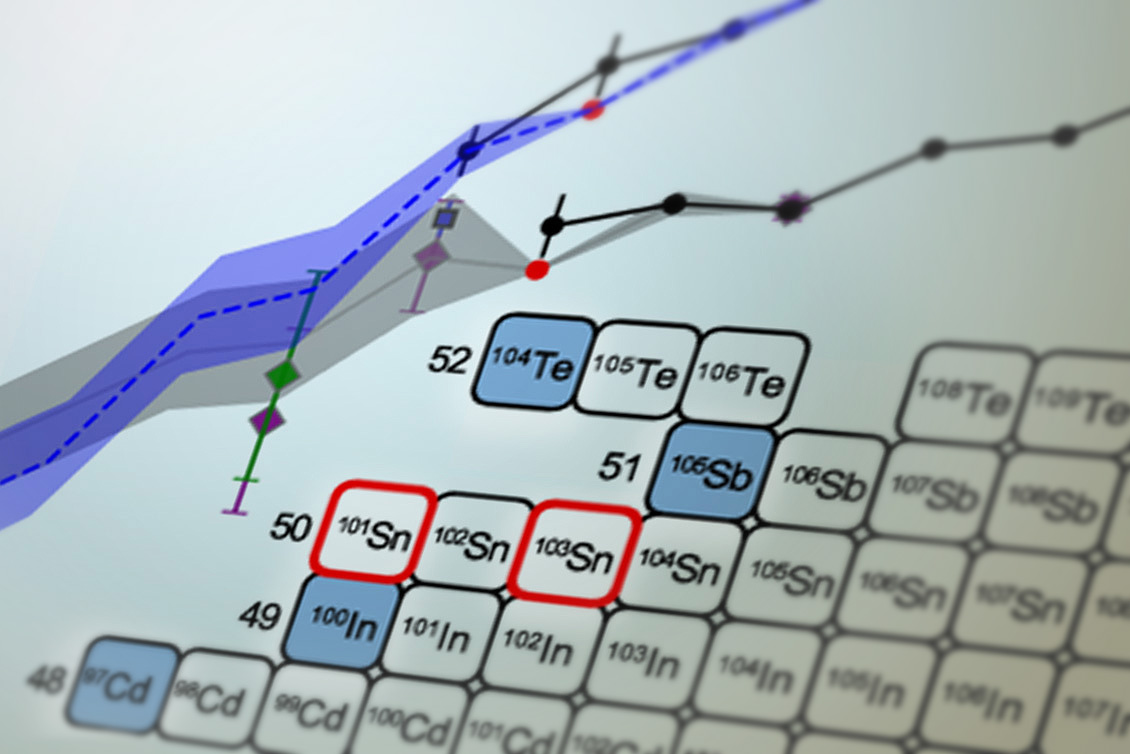
Tin-101 and tin-103 highlighted in a chart
Artificial intelligence/machine learning graphic A graphic showing surrogate models for linear responses

User facilities

FRIB hosts the world’s most powerful heavy-ion accelerator and enables discoveries in rare isotopes, nuclear astrophysics, fundamental interactions, and societal applications like medicine, security, and industry.

Explore FRIB user facilities

Learn more about upcoming events taking place at FRIB. 

View all events
  • 1 May 2026
  • 5:30 EDT
Advanced Studies Gateway Concert: Whoa Nelly Trio The Whoa Nelly Trio brings an evening of folk, country, Americana, roots, and gospel music to FRIB, blending traditional influences with original songs. https://frib.msu.edu/public-engagement/arts-and-activities-at-frib/advanced-stu…
  • 3 May 2026
  • 1:00 EDT
Advanced Studies Gateway public talk by Robert C. Smith: Has medicine lost its mind? – Why our mental health system is failing us and what should be done to cure it Robert C. Smith, University Distinguished Professor of Medicine and Psychiatry Emeritus at MSU, examines gaps in U.S. mental health care, where many patients do not receive treatment and care quality varies. He explores broader impacts, historical roots within medicine, and how public engagement and policy can help place mental and physical health on a more equal footing. Register at https://msu.zoom.us/webinar/register/WN_TYr4J76ZQHSLDhPNQmVH5A https://frib.msu.edu/public-engagement/arts-and-activities-at-frib/advanced-stu…
  • 4 May 2026
  • 10:00 EDT
Design of a High-Power Proton Linac and RFQ for the SSI Energy Amplifier Subcritical Systems Inc. (SSI, Austin, TX) is developing an Energy Amplifier (EA), an accelerator-driven system (ADS) designed for efficient and safe nuclear energy generation. Central to this concept is a high-power continuous-wave (CW) proton accelerator capable of delivering a 1.5 GeV beam to the EA's subcritical assembly at currents up to 14 mA, corresponding to a nominal beam power of 15–20 MW. The accelerator will include a radio-frequency quadrupole (RFQ) and a five-section superconducting linear accelerator (linac). The RFQ bunches and accelerates the proton beam to 5 MeV at 100% duty factor. The RFQ design was optimized using the code RFQ Designer and the beam dynamics were modeled with Toutatis. The superconducting linac is composed of five cryomodule sections employing half-wave resonator (HWR), single-spoke resonator (SSR), and elliptical cavity geometries to efficiently accelerate the beam to a final energy of 1.5 GeV. The linac layout was optimized using GenLinWin for shortest linac length and minimal beam loss. The full beam dynamics throughout the linac were then simulated using the TraceWin. In this seminar, the preliminary designs of both the RFQ and superconducting linac will be presented, and the current design challenges and future work will be discussed.
Training the next generation

Education & training

FRIB at MSU is a world-class research and training center where students and researchers from all career stages and backgrounds come together to make discoveries that change the world.

Explore FRIB training

External news and journal publications discussing FRIB.

View all articles
  • 4 March 2026
  • Lansing State Journal

Michigan State University's K500 Chip Testing Facility, inaugurated in February at FRIB, cost approximately $14 million to establish, with funding provided by the U.S. Department of Defense. The project repurposed the campus' K500 superconducting cyclotron, completed in 1982 for high-energy, heavy-ion research, including producing and accelerating ion beams to study nuclear structure, to now allow the facility to test semiconductors for space, defense and on-Earth applications.

https://www.lansingstatejournal.com/story/news/local/campus/2026/03/04/msu-micr…
  • 22 January 2026
  • Phys.org

Researchers have reported new experimental results addressing the origin of rare proton-rich isotopes heavier than iron, called p-nuclei. Led by Artemis Tsantiri, then-graduate student at FRIB and current postdoctoral fellow at the University of Regina in Canada, the study presents the first rare isotope beam measurement of proton capture on arsenic-73 to produce selenium-74, providing new constraints on how the lightest p-nucleus is formed and destroyed in the cosmos.

https://phys.org/news/2026-01-cosmic-rare-proton-rich-isotope.html
  • 26 March 2025
  • Lansing State Journal

One of the nation's premier research facilities located at Michigan State University is getting a multi-million dollar upgrade. Late last month, the U.S. Department of Energy Office of Science approved $49.7 million for MSU's Facility for Rare Isotope Beams.

https://www.lansingstatejournal.com/story/news/local/campus/2025/03/26/msu-frib…