
Welcome to FRIB
The Facility for Rare Isotope Beams (FRIB) at Michigan State University (MSU) is a world-unique research laboratory, hosting the most powerful rare-isotope accelerator. MSU operates FRIB as a user facility for the U.S. Department of Energy Office of Science (DOE-SC), with financial support from and furthering the mission of the DOE-SC Office of Nuclear Physics. FRIB is where researchers come together to make discoveries that change the world. They study the properties and fundamental interactions of rare isotopes and nuclear astrophysics and their impact on medicine, homeland security, and industry.
Research areas
FRIB advances nuclear science by improving our understanding of nuclei and their role in the universe, while also advancing accelerator systems.
Capabilities
In establishing and operating FRIB, capabilities were developed that transfer to other industries and applications.

User facilities
FRIB hosts the most powerful heavy-ion accelerator and enables discoveries in rare isotopes, nuclear astrophysics, fundamental interactions, and societal applications like medicine, security, and industry.
Learn more about upcoming events taking place at FRIB.
Education & training
FRIB at MSU is a world-unique research laboratory where students and researchers from all career stages and backgrounds come together to make discoveries that change the world.
External news and journal publications discussing FRIB.
Researchers have resolved a long-standing discrepancy in measurements of nuclear size in rare-earth elements, providing new insights into how nuclear charge radii change between neighboring elements. The study, published in Nature Communications, included FRIB faculty member Witek Nazarewicz and found that current nuclear theory cannot fully explain the unexpectedly large differences observed, providing new constraints for future experimental and theoretical studies.
A research team has reported the first experimental investigation of a nuclear physics reaction essential for understanding how the element strontium is produced in stars—specifically in stellar environments where traditional explanations for its formation fall short. The project was led by Caley Harris, a former graduate student at FRIB.
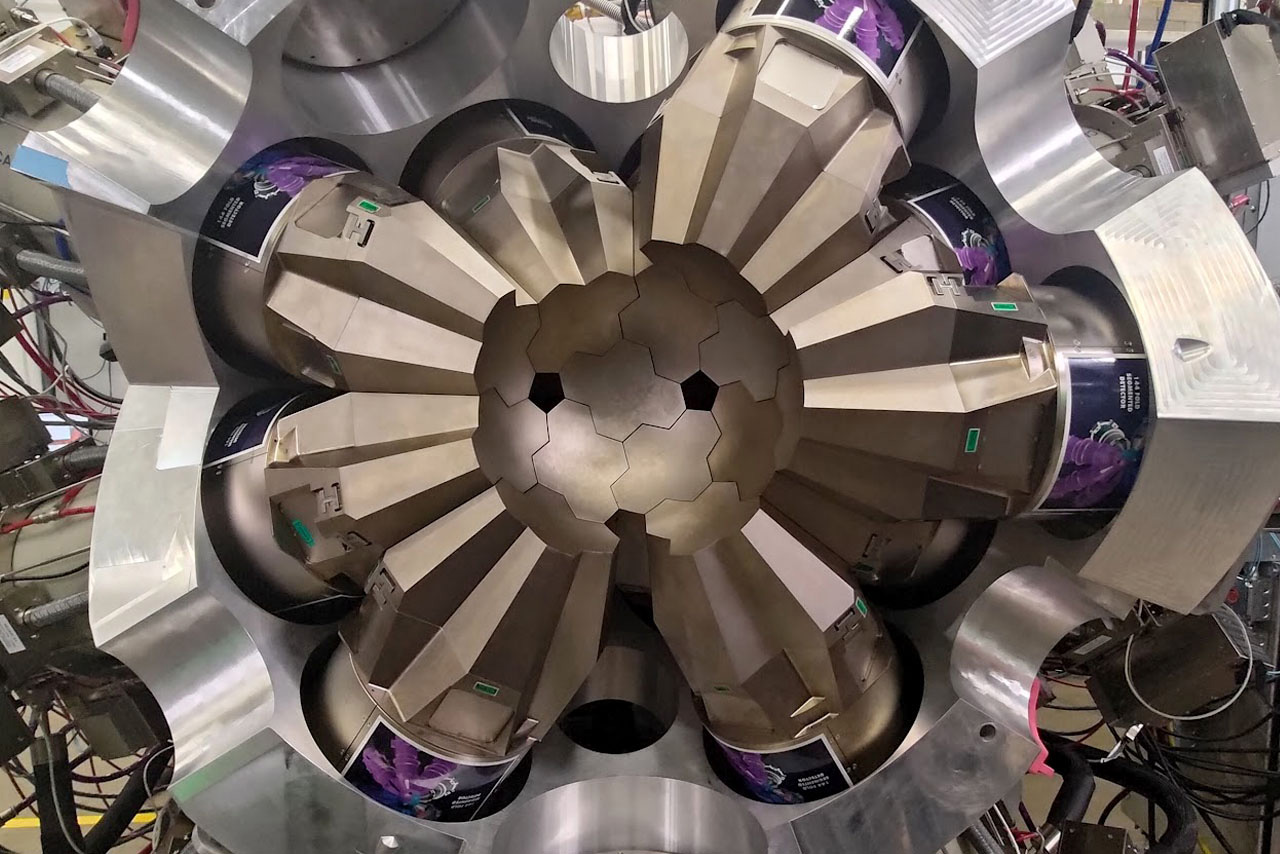
A next-generation nuclear detection system that could aid US national security efforts has logged its first operational measurements in Michigan. The Gamma-Ray Energy Tracking Array, known as GRETA, recently completed its initial characterization run at Michigan State University. Located at FRIB, the instrument met all primary performance targets during early beam testing.
Michigan State University's K500 Chip Testing Facility, inaugurated in February at FRIB, cost approximately $14 million to establish, with funding provided by the U.S. Department of Defense. The project repurposed the campus' K500 superconducting cyclotron, completed in 1982 for high-energy, heavy-ion research, including producing and accelerating ion beams to study nuclear structure, to now allow the facility to test semiconductors for space, defense and on-Earth applications.

