Terri Poxon-Pearson
Alumni Spotlight
Terri Poxon-Pearson earned a PhD in nuclear physics from Michigan State University, and she was at the National Superconducting Cyclotron Laboratory (NSCL) from 2014-2020. She is currently a physical scientist at the National Nuclear Security Administration (NNSA).
As a graduate student at NSCL, under the advisement of Filomena Nunes, professor of physics at FRIB and in MSU’s Department of Physics and Astronomy and the managing director of the FRIB Theory Alliance, Poxon-Pearson worked in the few-body nuclear reactions group. Her research focused on charge-exchange and transfer reaction theory with applications to nuclear astrophysics.
After graduation, Poxon-Pearson moved to Washington, D.C., to participate in the NNSA Graduate Fellowship Program (NGFP). NGFP is a year-long fellowship that places current or recent graduate students in NNSA program offices and serves as a bridge between graduate research and a career in nuclear security. During her fellowship, she worked on the NNSA’s nonproliferation missions in the Office of Management and Minimization supporting the Highly Enriched Uranium (HEU) disposition program. When her fellowship ended, Poxon-Pearson was able to transition to a federal position in the same office.
“Relatively early in my graduate studies I realized that I did not want a career in basic research,” Poxon-Pearson said. “However, I did have a longstanding interest in public policy and nuclear physics is ripe with societal applications. I was able to take advantage of some of the opportunities at the lab to learn more about nuclear nonproliferation.”
In her current position, Poxon-Pearson works in the Office of Plutonium Disposition, which is responsible for safely and permanently disposing of weapon-grade plutonium that has been declared excess to United States national security needs. Her portfolio includes managing programs at Los Alamos National Laboratory, Oak Ridge National Laboratory, and Savannah River National Laboratory.
Throughout her time at NSCL, Poxon-Pearson said she benefitted from mentors and advisors who supported her interests outside of research. Poxon-Pearson was heavily involved with Women and Minorities in the Physical Sciences (WaMPS) and said she was impressed by the support the group received from faculty and laboratory leadership. When she decided that she wanted to pursue a career in nuclear security, her advisor helped her build her network and develop the skills to support her goals.
“A foundation in nuclear physics has been helpful for understanding the challenges and constraints we encounter in nuclear facilities, but the most valuable skill in my everyday work is communication,” she said. “My graduate advisor, Filomena, understood the value of strong communication and I am grateful for the emphasis she places on helping students develop presentation and writing skills. Additionally, my experience as an NSCL tour guide was invaluable for learning how to communicate technical concepts to diverse audiences.”
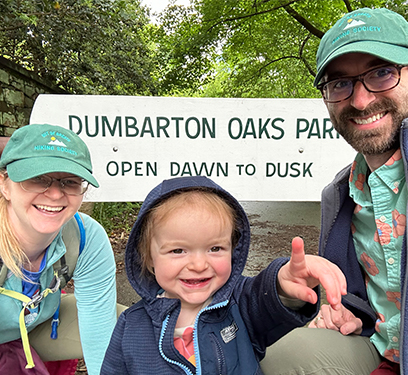
Outside of the office, Poxon-Pearson spends most of her time with her husband, Michael, and their two-year-old daughter, Sylvia. The family enjoys hiking and cooking together. In her free time, Poxon-Pearson enjoys running and ballroom dancing with Michael.

