Andrew Sanchez
Alumni Spotlight
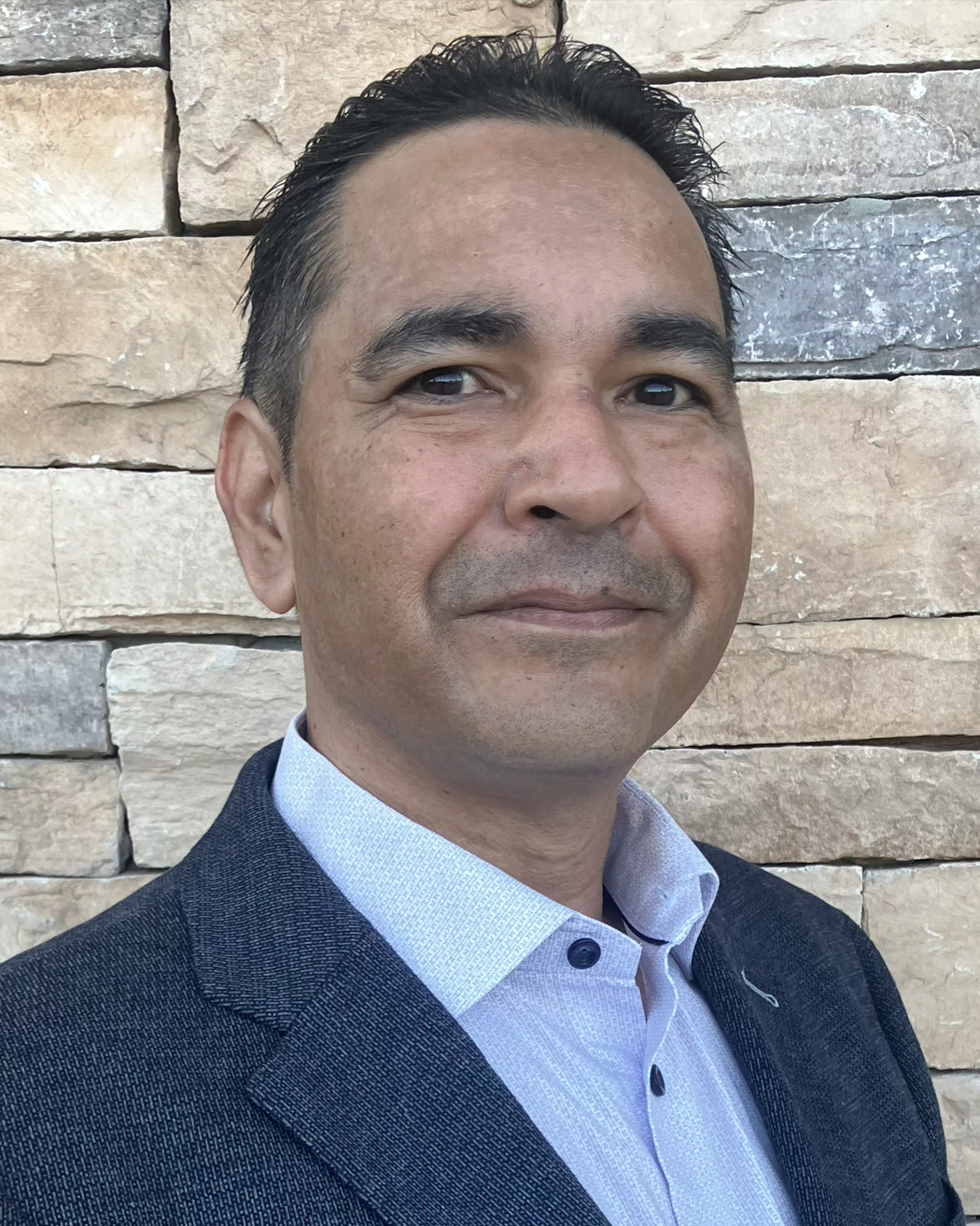
Andrew Sanchez earned a PhD in physics from Michigan State University and was at the National Superconducting Cyclotron Laboratory (NSCL) from 2019–2024. He is currently a physicist for Pajarito Scientific Corporation (PSC) in Santa Fe, New Mexico.
As a graduate student at NSCL and FRIB, Sanchez’s research focused on mirror nuclei, specifically those near doubly magic calcium-40. Working under his advisor, Hironori Iwasaki, professor of physics at FRIB, Sanchez used techniques like the Recoil Distance Method to measure the lifetimes of excited nuclear states that exist for only tens of picoseconds. These measurements offer a model-independent way to determine reduced transition strengths, which can provide insight into the isospin symmetry breaking phenomena.
Sanchez first discovered NSCL/FRIB when he took part in the first Nuclear Science Summer School (NS3) in 2016.
“My academic and career path was heavily impacted by my experiences at NSCL/FRIB,” Sanchez said. “I really had no idea of what experimental nuclear physics entailed until NS3. It was there that I learned that the nucleus is a playground for three of the four fundamental forces (strong, electromagnetism, and weak) and that experimental nuclear physics would give me the broad skill set that I desired (from modeling and calculations to hands-on work with detectors and electronics). The experience I gained with gamma spectroscopy and high-purity germanium (HPGe) detectors, specifically, were highly marketable skills in nuclear industry and are the skills I use daily in my current job.”
Sanchez’s current employer, PSC, provides specialized radiometric instrumentation systems and services to Department of Energy (DOE) and commercial nuclear clients. His work focuses on non-destructive assay, which uses spectroscopy for radionuclide identification and quantification. He is also preparing to step into a role as a Radiation Safety Officer (RSO) at PSC.
“My work with HPGe detectors and gamma spectroscopy at FRIB was readily transferable to the non-destructive assay field,” he said. “And my experience working with radioactive sources at FRIB provided the skills necessary to fill the RSO role.”
Sanchez describes earning his PhD at FRIB as a highly valuable experience, highlighting the unique opportunity to collaborate with talented and accomplished researchers from around the world.
“Being able to walk down the hall to ask a theorist a question or have lunch with a detector specialist, accelerator operator, or field expert and pick their brain is just awesome,” Sanchez said. “I definitely grew as a person and scientist, and it was so fulfilling to watch that same growth in my peers.”
In his personal time, Sanchez enjoys skateboarding and says he often can be found enjoying Santa Fe’s local skateparks and meeting new people. He and his significant other recently adopted two cats—a brother and sister duo named Chester the Salamander Prince and Little Izzy Greenberg.
Become an MSU/FRIB graduate student
If you’re seeking a graduate degree in nuclear physics, chemistry, or engineering, seize the unique opportunity to do research at a national user facility located on the campus of a major research university.

