
Assistant Professor of Physics
Joined the laboratory in 2024
Education and training
- PhD, Physics, University of California Los Angeles, 2021
Contact information
Research
I study thermodynamic properties of dense nuclear matter to quantify and understand how it reacts to changes of its macroscopic characteristics such as density or temperature. This line of study can reveal key insights into the elementary mechanisms governing nuclear matter which, while in principle described by quantum chromodynamics (QCD), are most often inaccessible to direct QCD calculations.
Determining the behavior of QCD matter in extreme environments—such as supernova explosions, neutron stars and their mergers, and, in laboratories on Earth, relativistic collisions of heavy nuclei—can help answer the following broad questions:
- How do thermodynamic properties of nuclear matter evolve with density, temperature, and isospin fraction?
- How do the dominant nuclear matter degrees of freedom (e.g., nuclei, nucleons, hadrons, or quarks and gluons) and their properties change as the thermodynamic variables are varied?
- What is the nature of the phase transition (e.g., first or second order, crossover, etc.) between the dominant QCD degrees of freedom at different densities, temperatures, and isospin fractions?
I aim to answer these questions by studying collisions of heavy nuclei at relativistic speeds, which briefly produce regions of extremely hot and dense nuclear matter. I extract properties of nuclear matter by modeling these experiments with dynamic simulations and comparing simulation results to experimental data. This research benefits from close collaboration with both heavy-ion experimentalists and complementary efforts in nuclear theory, e.g., neutron star studies or ab initio calculations.
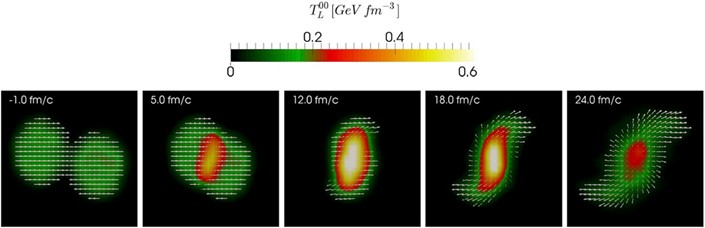
Snapshots of the time evolution of a collision of two gold nuclei at the center-of-mass energy of 2.24 GeV and an impact parameter of 3 fm, simulated with the SMASH hadronic transport code. The local energy density is indicated with colors as specified in the legend. The Landau-frame velocity of baryons in the system is visualized with arrows and is proportional to the arrow length; the maximal arrow length corresponds to a velocity of 0.55 c. Figure from Weil et al., Phys Rev C (2016) 94:054905.
Biography
I grew up in a small town in southwestern Poland. My interest in physics began not in school, but through reading about particle physics in Scientific American. Once in college, in addition to my original interest in particle physics, I also loved the complexities explored in the statistical mechanics class, but there were no research opportunities in that direction. Fortunately, I then joined a group that combined both of these interests by studying physics probed by heavy-ion collisions: enormously hot, dense, and complex systems governed by fundamental interactions between elementary particles. After earning my Master’s degree, I went on to graduate school at UCLA, where I took the opportunity to carry out research in various areas, including experimental neutrino physics and theoretical studies of neutron stars. Ultimately, when a possibility to return to heavy-ion physics arose, I pursued it without hesitation. I completed most of my Ph.D. work at Lawrence Berkeley National Laboratory, then went on to a postdoc at the Institute for Nuclear Theory at the University of Washington before starting my faculty position at FRIB in 2024.
How students can contribute as part of my research team
Members of my group primarily work with transport model simulations of heavy-ion collisions. These computational frameworks are continuously developed to enable better interpretation of observables measured in upcoming FRIB and other heavy-ion collision experiments worldwide. Projects in my group include building models of key aspects of heavy-ion collision physics for simulations, introducing new modules to existing numerical frameworks, and confronting the numerical models with experimental data. The latter relies heavily on high-performance computing, Bayesian methods, and machine learning techniques.
Scientific publications
- Structure in the speed of sound: From neutron stars to heavy-ion collisions, N. Yao, A. Sorensen, V. Dexheimer, J. Noronha-Hostler, Phys. Rev. C 109 6, 065803 (2024).
- Dense nuclear matter equation of state from heavy-ion collisions, A. Sorensen et al., Prog. Part. Nucl. Phys. 134, 104080 (2024).
- Sensitivity of Au+Au collisions to the symmetric nuclear matter equation of state at 2–5 nuclear saturation densities, D. Oliinychenko, A. Sorensen, V. Koch, L. McLerran, Phys. Rev. C 108 3, 034908 (2023).

