DOE-SC highlight: Predictive theory improves understanding of alpha processes
Share this article:
Share this article:
A team of researchers from FRIB and Lawrence Livermore National Laboratory have improved predictions for nuclear fusion reactions that drive the formation of heavy elements. The U.S. Department of Energy Office of Science (DOE-SC) recently published a highlight describing the team’s experiment and analysis.
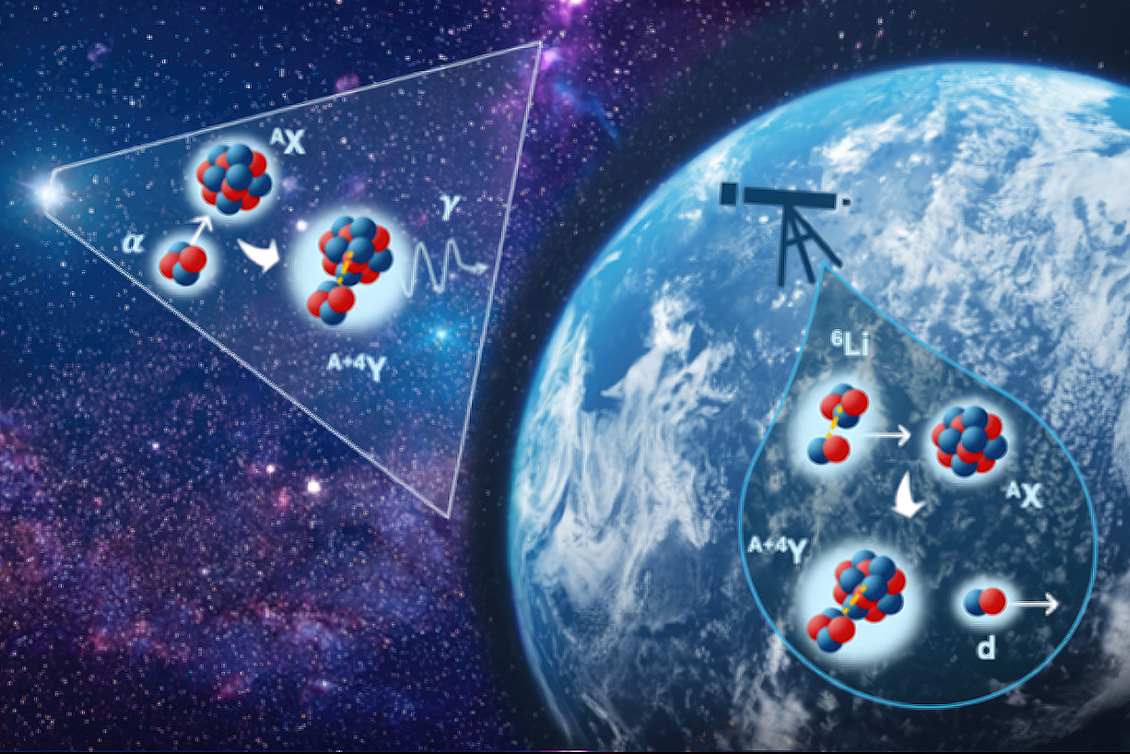
Using an advanced theoretical framework, the researchers predicted the fusion of helium (α) and deuterium to form lithium-6. By incorporating validated two- and three-nucleon interactions from chiral effective field theory, the team reduced the uncertainty in the reaction rate by a factor of seven. These new calculations have also reassessed and confirmed the discrepancies between the observed and predicted abundance of lithium-6 in the early universe.
The team also collaborated with a researcher from Argonne National Laboratory to reassess the transfer reactions in which an α is transferred from a lithium-6 to a carbon-12 and carbon-13 to form oxygen-16 and oxygen-17, used to probe their low-energy properties. Their calculations led to a 21-percent reduction in the estimated cross section for the fusion of helium (α) and carbon-12 to form oxygen-16. They also resolved between two recent evaluations of fusion rates of particles with carbon-13 to produce oxygen-16 and a neutron in small to medium-size stars. Looking ahead, the team sees this enhanced theoretical model as a foundation for improving predictions of many other alpha fusion processes in astrophysics.
Each year, scientists publish thousands of research findings in scientific literature. About 200 of these are selected annually by their respective program areas in DOE-SC as publication highlights of special note.
Read the highlight on the DOE-SC website.
Michigan State University (MSU) operates the Facility for Rare Isotope Beams (FRIB) as a user facility for the U.S. Department of Energy Office of Science (DOE-SC), with financial support from and furthering the mission of the DOE-SC Office of Nuclear Physics. Hosting the most powerful heavy-ion accelerator, FRIB enables scientists to make discoveries about the properties of rare isotopes in order to better understand the physics of nuclei, nuclear astrophysics, fundamental interactions, and applications for society, including in medicine, homeland security, and industry. User facility operation is supported by the DOE-SC Office of Nuclear Physics as one of 28 DOE-SC user facilities.
The U.S. Department of Energy Office of Science is the single largest supporter of basic research in the physical sciences in the United States and is working to address some of today’s most pressing challenges. For more information, visit energy.gov/science.

