FRIB hosts first workshop on detectors and data acquisition systems for nuclear physics
Share this article:
Share this article:
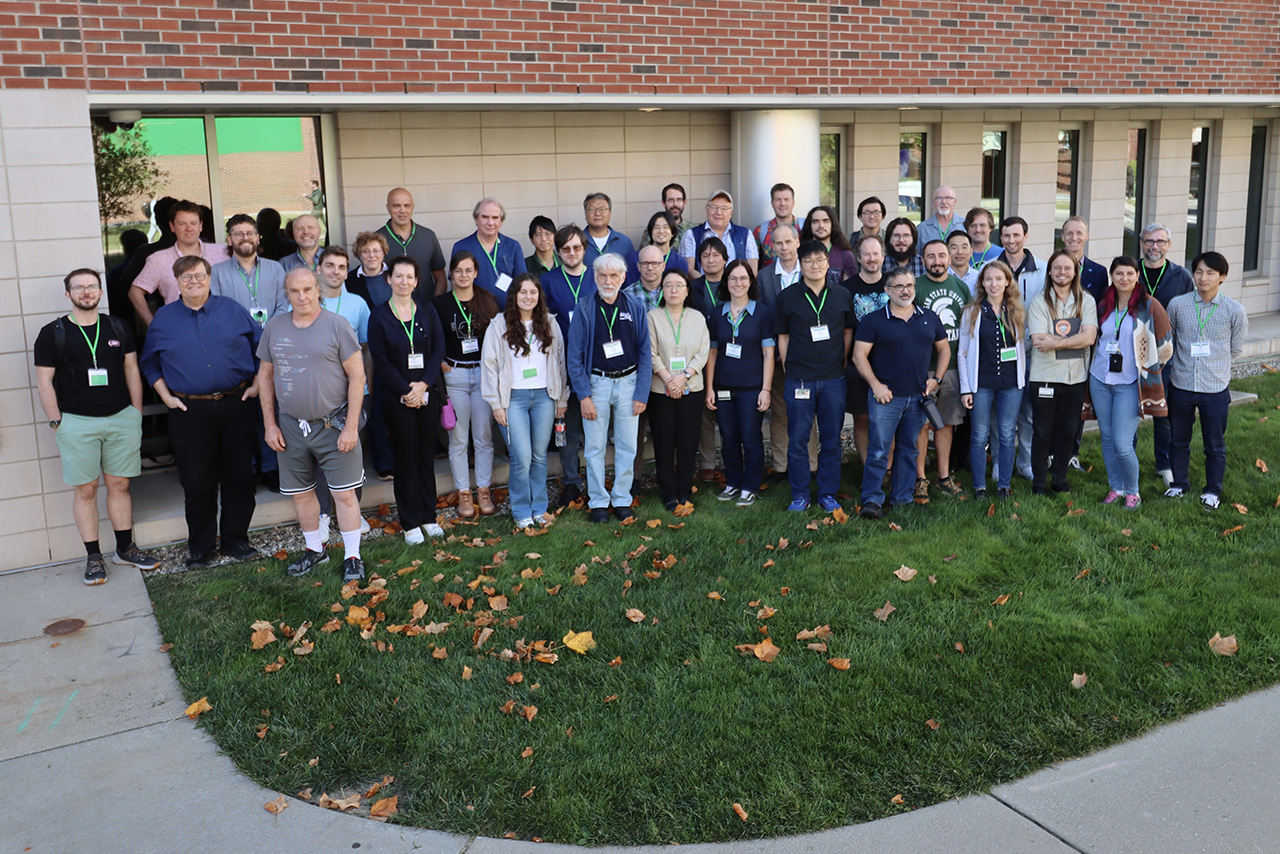
FRIB hosted the first Workshop on New Generations of Detectors and Data Acquisition Systems for Nuclear Physics (NextGenDD25) from 29 September 29 to 3 October. The attendees at the event represented national and international laboratories and universities. FRIB hosted NextGenDD25, the first conference of its kind, to encourage collaboration on detector and data acquisition technology to support nuclear physics experiments.
Participants discussed the design, construction, development, and operations of new detectors and data acquisition system for radioactive beam facilities and experimental setups. The workshop brought together experts to discuss recent achievements, future upgrades, and new projects focusing on technical collaborations between laboratories.
Workshop participants examined the integration of artificial intelligence and machine learning with intelligent signal processing to improve event selection, real-time decision-making, particle identification, and data handling in high-rate nuclear physics experiments.
Topics for NextGenDD25 included
- heavy-ion tracking,
- high-resolution timing detectors,
- new focal-plane detectors for particle identification,
- novel radiation-hard detector concepts for high-rate applications,
- data acquisition and trigger technologies,
- artificial intelligence and machine learning,
- front-end electronics,
- fast digitizers,
- fast transfer links, and
- networks.
Michigan State University (MSU) operates the Facility for Rare Isotope Beams (FRIB) as a user facility for the U.S. Department of Energy Office of Science (DOE-SC), with financial support from and furthering the mission of the DOE-SC Office of Nuclear Physics.

