FRIB researcher awarded grant to explore actinide chemistry for element separation
Share this article:
Share this article:
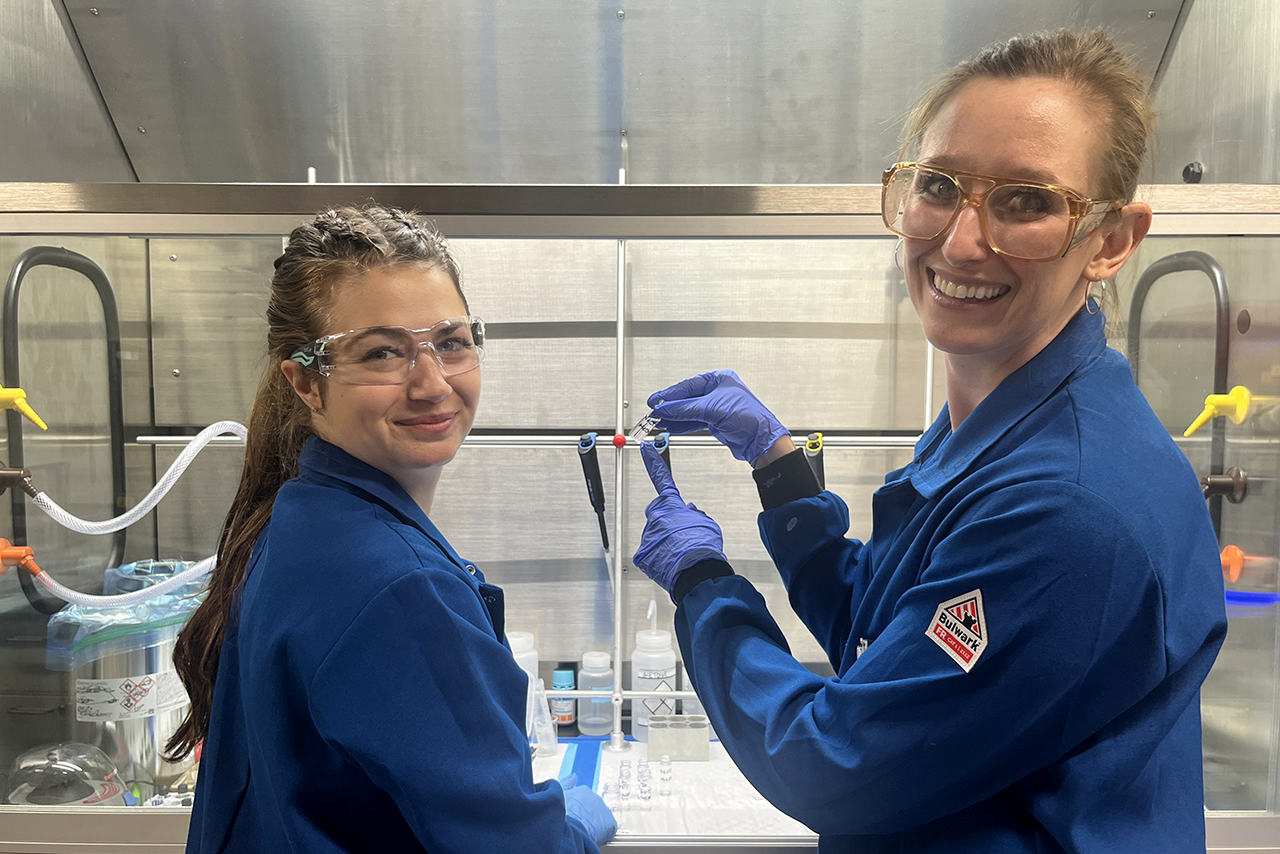
The U.S. Department of Energy (DOE) National Nuclear Security Administration (NNSA) has awarded a grant to Alyssa Gaiser, assistant professor of chemistry at FRIB and in Michigan State University’s Department of Chemistry. Her project, titled “Exploring Varied Oxidation States of Plutonium, Americium, and Curium Tris Pyrazolyl Borate Complexation for Separations,” will focus on finding better ways to separate certain actinide elements. Gaiser will work with Emily Gordon, graduate assistant at FRIB, and Melissa Fairley Rier, staff scientist at Los Alamos National Laboratory.
The project centers on three elements—americium, curium, and plutonium—that are important for nuclear energy, isotope production, national security, and space exploration. The research at MSU involves americium and curium, and the plutonium work is performed at Los Alamos.
These elements are hard to separate because they have similar chemical properties. Current methods are inefficient and often use harsh chemicals, so new, more effective techniques are needed.
Gaiser’s team will investigate tris pyrazolyl borates to separate these elements. Changing the shape and makeup of these molecules influences how well they dissolve in liquids and how they interact with the metals. A key goal is to make it easier to separate americium from curium, two elements that are especially chemically similar.
The researchers will create and study both radioactive and nonradioactive compounds to better understand their chemical behavior. Their work could create new ways to separate these elements more safely and efficiently, using techniques like selective precipitation or liquid-liquid extraction.
This research is supported by the U.S. Department of Energy’s National Nuclear Security Administration under Award Number DE-NA0004255.
Michigan State University (MSU) operates the Facility for Rare Isotope Beams (FRIB) as a user facility for the U.S. Department of Energy Office of Science (DOE-SC), with financial support from and furthering the mission of the DOE-SC Office of Nuclear Physics. Hosting the most powerful heavy-ion accelerator, FRIB enables scientists to make discoveries about the properties of rare isotopes in order to better understand the physics of nuclei, nuclear astrophysics, fundamental interactions, and applications for society, including in medicine, homeland security, and industry. User facility operation is supported by the DOE-SC Office of Nuclear Physics as one of 28 DOE-SC user facilities.
The U.S. Department of Energy Office of Science is the single largest supporter of basic research in the physical sciences in the United States and is working to address some of today’s most pressing challenges. For more information, visit energy.gov/science.
Become an MSU/FRIB graduate student
If you’re seeking a graduate degree in nuclear physics, chemistry, or engineering, seize the unique opportunity to do research at a national user facility located on the campus of a major research university.

