Michigan delegation's congressional staff members visit FRIB
Share this article:
Share this article:
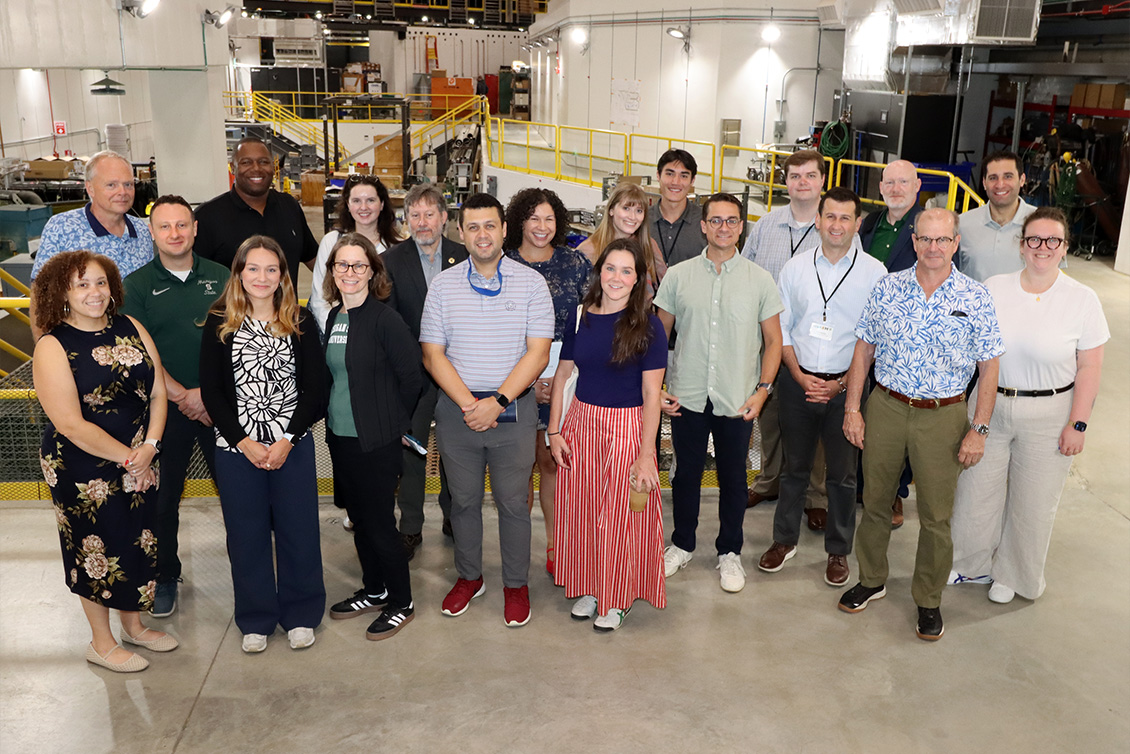
Congressional staff members from Michigan’s U.S. Senate and U.S. House of Representatives offices visited FRIB on 6 August. The visit was part of the 2025 Research Universities for Michigan (RU4M) research tour.
FRIB Laboratory Director Thomas Glasmacher hosted the bipartisan group’s visit, which included a discussion about the scientific and technological advancements taking place at FRIB and a tour, including the High Rigidity Spectrometer (HRS) vault, FRIB’s single event effects (SEE) facilities, and the Rare Isotope Harvesting Vault building addition.
FRIB has received consistent bipartisan and bicameral support since it was first awarded to Michigan State University (MSU). Over the years, this support has played a critical role in the development and advancement of the facility’s research capabilities.
MSU operates FRIB as a user facility for the U.S. Department of Energy Office of Science (DOE-SC), with financial support from and furthering the mission of the DOE-SC Office of Nuclear Physics. Hosting the most powerful heavy-ion accelerator, FRIB enables scientists to make discoveries about the properties of rare isotopes to better understand the physics of nuclei, nuclear astrophysics, fundamental interactions, and applications for society, including in medicine, homeland security, and industry. User facility operation is supported by the DOE-SC Office of Nuclear Physics as one of 28 DOE-SC user facilities.
HRS is a scientific instrument that will serve as the core of FRIB’s fast-beam program. With near 100-percent efficiency, HRS will transmit isotopes that travel at velocities high enough for optimal rare-isotope production rates—around 50 percent of the speed of light. HRS will enable scientists to identify the properties of isotopes, such as mass, charge, and velocity, created in these rare-isotope reactions. A scientific user community of over 500 scientists for HRS is expected. In February, DOE-SC approved the start of execution of a $49.7 million instrument at FRIB: the High-Transmission Beam Line (HTBL), the first of the two segments of HRS. FRIB will present technical progress to DOE-SC at a review in October.
In addition to basic research, FRIB supports U.S. industry by helping address the national shortage of microelectronics testing. Its heavy-ion facilities—including the FRIB Single Event Effects Facility (FSEE) and the in-progress K500 Chip Testing Facility (KSEE)—are essential for testing chips used in spaceflight, wireless tech, and autonomous vehicles. In 2024, the federal government awarded $14 million to MSU to build KSEE, repurposing the historic K500 cyclotron into a next-generation testing tool for industry.
The Rare Isotope Harvesting Vault supports isotope harvesting at FRIB. During routine operation for its nuclear physics mission—without interfering with FRIB’s primary users—extra, unused isotopes can be “harvested.” Rare isotopes have a role in multiple fields of study, such as medicine, biochemistry, materials science, horticulture, and astrophysics. The DOE Isotope Program provided funding for FRIB’s isotope harvesting project to establish the capability and now supports operations and research.
Continued congressional backing has included funding for key initiatives such as the FRIB400 upgrade and HRS, both of which are essential to expanding the scientific reach of the facility. Future funding commitments will allow FRIB to sustain and enhance its contributions to the national research infrastructure.
The visiting group included:
- Brian Askren, legislative assistant for the Office of Representative Tim Walberg (Michigan’s fifth congressional district)
- Peter Butkovich, legislative assistant for the Office of Representative Kristen McDonald Rivet (Michigan’s eighth congressional district)
- John Damoose, legislative correspondent for the Office of Representative Jack Bergman (Michigan’s first congressional district)
- Leila Fleming, senior legislative assistant for the Office of Representative Hilary Scholten (Michigan’s third congressional district)
- Matt Franklin, regional manager for the Office of Senator Elissa Slotkin (Michigan)
- Robert Fumai, legislative aide for the Office of Representative Tom Barrett (Michigan’s seventh congressional district)
- Hannah Marsh, legislative assistant for the Office of Representative Hilary Scholten (Michigan’s third congressional district)
- Maria Moore, community events and grants manager for the Office of Senator Elissa Slotkin (Michigan)
- Anna Murray, legislative aide for the Office of Senator Elissa Slotkin (Michigan)
- Josh Shapiro, senior legislative assistant for the Office of Representative Debbie Dingell (Michigan’s sixth congressional district)
- Savannah Ware, legislative aide for the Office of Senator Elissa Slotkin (Michigan)

