BEam COoler and LAser spectroscopy (BECOLA)
Instruments
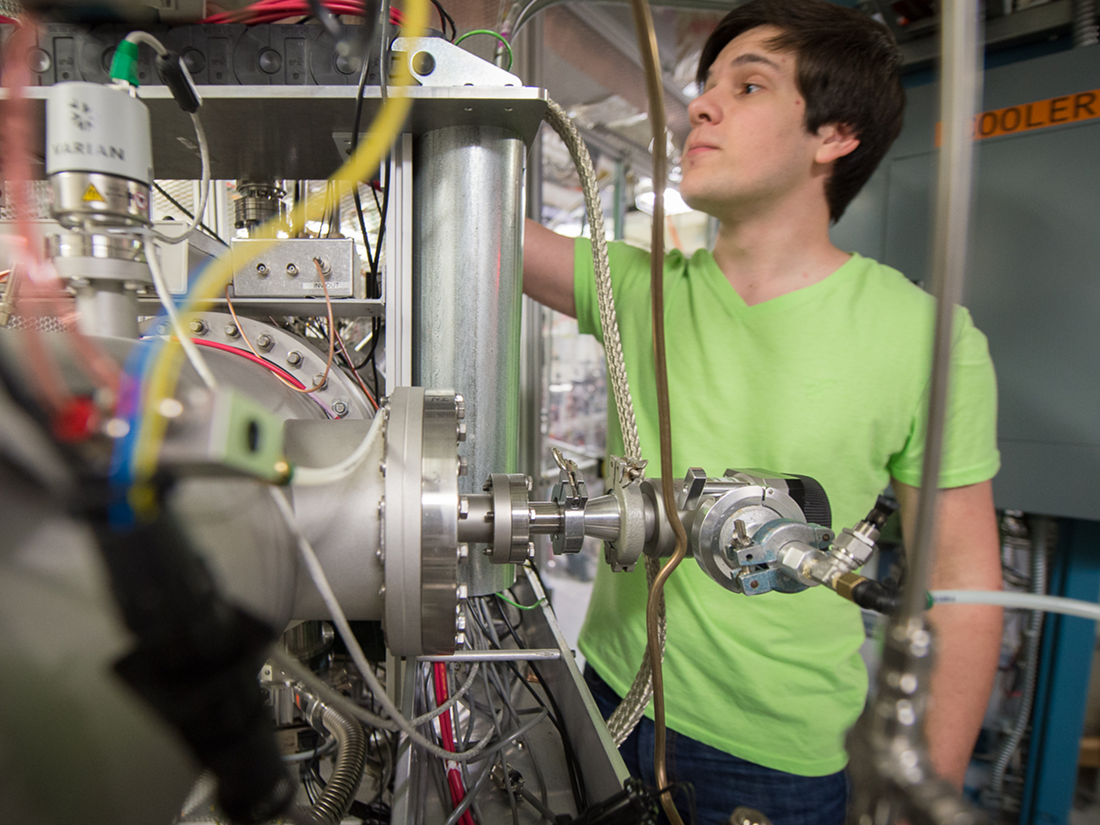
BECOLA is a facility for collinear laser spectroscopy and beta-nuclear magnetic resonance (NMR) studies.
Status: Operational
Location: Room 1361
Contact person: Kei Minamisono
Overview
High-energy, rare-isotope beams are produced by FRIB. These beams are purified using the FRIB fragment separator prior to being sent to the Gas Stopping Facility where the fast, relativistic beams are stopped and extracted as low-energy beams, and delivered to the BECOLA facility.
At BECOLA, the low-energy beam is first cooled and bunched in a radiofrequency ion trap filled with a helium buffer gas. The rare isotopes are then delivered in bunches to the collinear laser spectroscopy beam line, where the laser resonant fluorescence measurements and the Resonant Ionization Spectroscopy Experiment (RISE) are performed.
The BECOLA facility also includes a dedicated offline ion source (a discharge plasma sputtering source) to produce stable isotopes of metallic and gaseous elements for calibration and monitoring purposes. Also there is a charge exchange cell to produce neutral beams through the atomic charge exchange reactions with alkali vapor (typically sodium).
Polarized beams are available for selected element, which is produced using optical pumping technique. A beta-NMR setup or a user provided experimental device may be placed downstream of BECOLA to accept the polarized beam.
Funding acknowledgement: The BECOLA project is funded by NSF under PHY-11-02511, PHY-12-28489 (MRI), PHY-15-65546, PHY-21-11185 and DOE NNSA DE-NA0002924.

