Winners of the 2026 FRIB Achievement Award for Early Career Researchers named
Share this article:
Share this article:
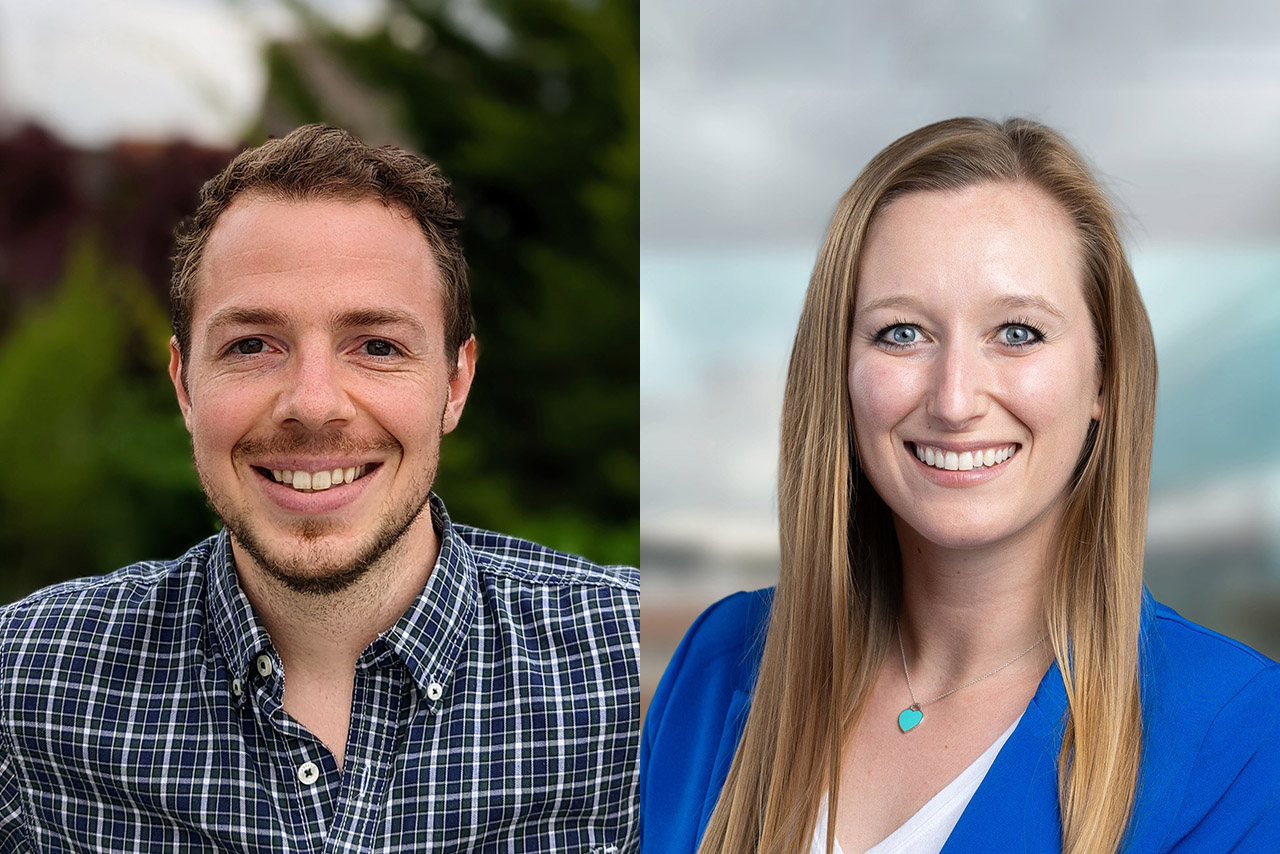
The FRIB Users Organization Executive Committee and the FRIB Theory Alliance Executive Board have announced the winners of the 2026 FRIB Achievement Award for Early Career Researchers. Alyssa Gaiser, assistant professor of chemistry at Michigan State University (MSU) and FRIB, is the recipient of the 2026 experimental award. Matthias Heinz, Eugene P. Wigner Fellow at Oak Ridge National Laboratory, is the recipient of the 2026 theory award.
The selection committee stated:
Dr. Alyssa Gaiser is a radiochemist who has made significant contributions to FRIB science by supporting the fundamental symmetries user community as well leading a research program centered around the use of isotopes for societal applications. She has developed radiochemical protocols to reliably and efficiently produce a source of radium and radium-containing molecules, enabling the progress of fundamental symmetries teams. Her technical innovation led to the synthesis and characterization of the first promethium-containing crystals, which can ultimately be used for cancer treatment and nuclear batteries. Dr. Gaiser’s impressive scientific leadership and technical developments were noted by all committee members and her commitment to public engagement and workforce development was also highly commended.
Dr. Matthias Heinz has made exceptional contributions to ab initio nuclear theory and its direct application to FRIB science. His development of the IMSRG(3)—the first inclusion of three-body operators in the in-medium similarity renormalization group framework—represents a genuine methodological breakthrough that has improved the precision of nuclear structure calculations by a factor of two to three. Equally compelling is Dr. Heinz's close and productive engagement with the FRIB experimental program. All of this has been accomplished less than two years after completing his PhD, making his record of achievements truly remarkable.
Alyssa Gaiser
Gaiser's research focuses on radiochemistry and the use of radioactive isotopes for applications in medicine, energy, and nuclear science. At FRIB, she leads the Gaiser Group, whose research explores the fundamental chemistry of elements such as radium and promethium to develop methods for isolating their isotopes for nuclear physics measurements. This research supports the development of targeted cancer therapies, nuclear batteries, and technologies for managing spent nuclear fuel.
Gaiser uses FRIB's isotope harvesting and radiochemistry capabilities to support both fundamental and applied research. She is also part of an interdisciplinary effort to develop a streamlined pipeline for producing and evaluating promethium-149–based radiopharmaceuticals for cancer treatment. The work relies on FRIB's unique ability to produce rare isotopes that are difficult or impossible to obtain elsewhere.
“FRIB not only has created a collaborative space to network with world-leading scientists invested and interested in the same elements my research uses but also helps provide those elements for our chemistry experiments,” Gaiser said.
Beyond advancing nuclear science, Gaiser and her research group study the chemistry of lanthanides and actinides to develop improved methods for separating these chemically similar elements. This work could help secure supplies of critical materials needed for medicine, energy, national security, and other applications.
"Our chemistry helps broaden the library of available isotopes for medicinal treatments," Gaiser said.
Through the Gaiser Group, Gaiser also trains the next generation of radiochemists to safely work with radioactive materials, helping build the workforce needed to support future advances in nuclear energy and radiochemistry.
Gaiser earned her bachelor's degree in chemistry, with a minor in mathematics, from the University of California, Los Angeles, in 2016. She completed her PhD in inorganic chemistry at Florida State University in 2020 and was a postdoctoral fellow under the supervision of Rebecca Abergel at Lawrence Berkeley National Laboratory before joining MSU and FRIB as an assistant professor of chemistry in 2022.
Matthias Heinz
Heinz develops computational methods that improve first-principles calculations of atomic nuclei. His research examines fundamental interactions involving nuclei, including electroweak processes and possible physics beyond the Standard Model, while advancing methods to compute the dynamics of medium-mass and heavy nuclei.
"My research roots the structure of nuclei in our understanding of nuclear forces," Heinz said. "The improved methods I have developed are important for precision and uncertainty quantification, allowing more robust comparison between theory and experiments, including those performed at FRIB.”
Heinz is particularly excited about the interplay between nuclear theory, modern statistical methods, and experiments to explore nuclear structure near the drip lines. Combining experimental measurements with theoretical predictions and statistical analyses, he said, will help scientists better understand nuclear structure and dynamics at the limits of nuclear stability.
Looking ahead, Heinz said precise measurements of ground-state properties and spectra in neutron-rich nuclei will continue to test scientists' understanding of nuclear forces in exotic environments. He also emphasized that developments in nuclear theory have applications beyond basic research.
"Nuclear theory research leverages and develops novel methods and technologies, including large-scale supercomputers, quantum computers, emulators built using machine learning techniques, and modern statistical methods," Heinz said. "These developments enable new approaches in important societal applications, including nuclear data and nuclear energy, as clearly seen within the national laboratory ecosystem."
Heinz earned his bachelor's degree from The Ohio State University in 2018, where he researched low-resolution nuclear forces with Richard Furnstahl. He completed his PhD in physics at the Technical University of Darmstadt in 2024 under the supervision of Achim Schwenk, focusing on improved first-principles computations of atomic nuclei.
The FRIB Achievement Award for Early Career Researchers recognizes outstanding original contributions to the field of nuclear physics through work at or relating to FRIB, performed by scientists early in their careers.
The recipients will present their work during the plenary session at the annual Low Energy Community Meeting and receive a stipend to support their participation.
Michigan State University (MSU) operates the Facility for Rare Isotope Beams (FRIB) as a user facility for the U.S. Department of Energy Office of Science (DOE-SC), with financial support from and furthering the mission of the DOE-SC Office of Nuclear Physics.
The U.S. Department of Energy Office of Science is the single largest supporter of basic research in the physical sciences in the United States and is working to address some of today’s most pressing challenges. For more information, visit energy.gov/science.

